| 文物統一編號 |
故畫002894N000000000
|
| 作品號 |
故畫00289400000 |
| 品名 |
清艾啟蒙畫風猩 軸
Feng-hsing (Slow Loris) |
| 分類 |
繪畫 |
| 作者 |
艾啟蒙 |
| 數量 |
一軸 |
| 印記類別 |
印主 |
印記 |
| 鑑藏寶璽 |
清內府印 |
三希堂精鑑璽 |
| 鑑藏寶璽 |
清高宗 |
石渠定鑑 |
| 鑑藏寶璽 |
清內府印 |
石渠寶笈 |
| 鑑藏寶璽 |
清內府印 |
宜子孫 |
| 鑑藏寶璽 |
宣統帝 |
宣統御覽之寶 |
| 鑑藏寶璽 |
清高宗 |
乾隆御覽之寶 |
| 鑑藏寶璽 |
清高宗 |
乾隆鑑賞 |
| 鑑藏寶璽 |
清仁宗 |
嘉慶御覽之寶 |
| 鑑藏寶璽 |
清高宗 |
養心殿鑑藏寶 |
| 鑑藏寶璽 |
清高宗 |
寶笈重編 |
| 主題類別 |
主題(第一層) |
主題(第二層) |
主題說明 |
| 次要主題 |
樹木 |
梧桐 |
|
| 其他主題 |
走獸 |
猿 |
風猩 |
| 其他主題 |
花草 |
|
花 |
| 其他主題 |
花草 |
芙蓉 |
|
| 其他主題 |
花草 |
桂花 |
|
| 其他主題 |
花草 |
菊 |
|
| 類別 |
參考資料 |
| 內容簡介 |
艾啟蒙,(西元一七0八至一七八0年),字醒菴,波西米亞人。乾隆十年入如意館,與朗世寧、王致誠同為畫院供奉。善畫,尤工翎毛,賜三品銜。
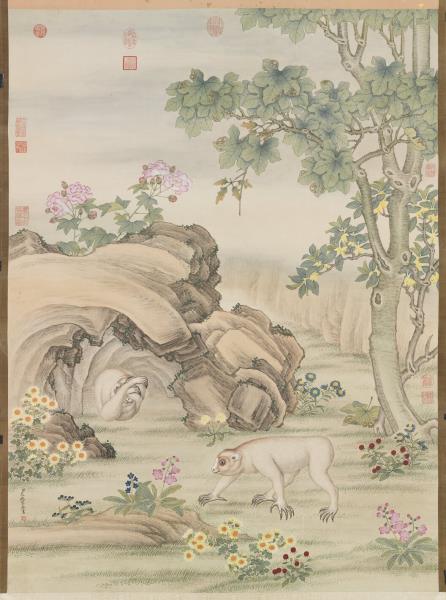
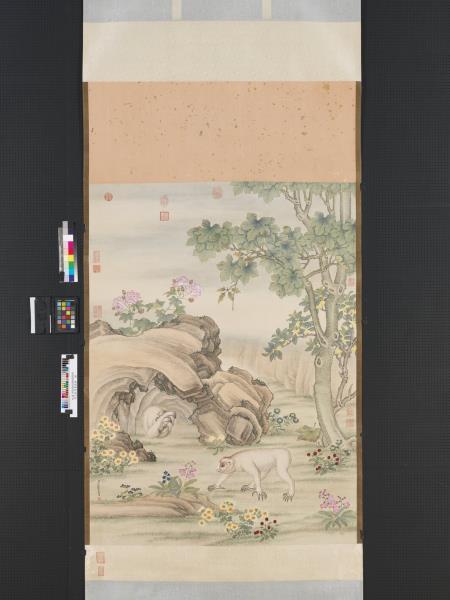
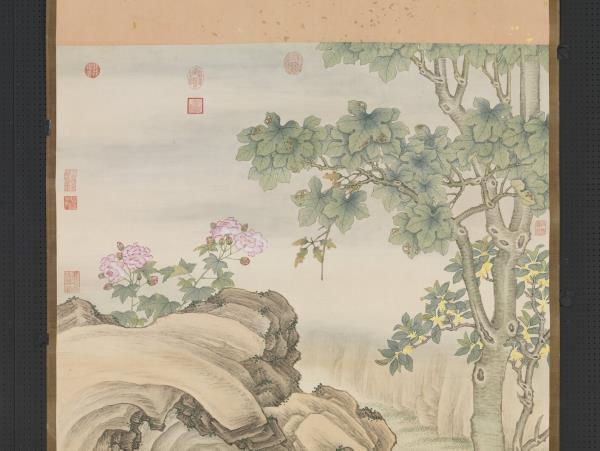
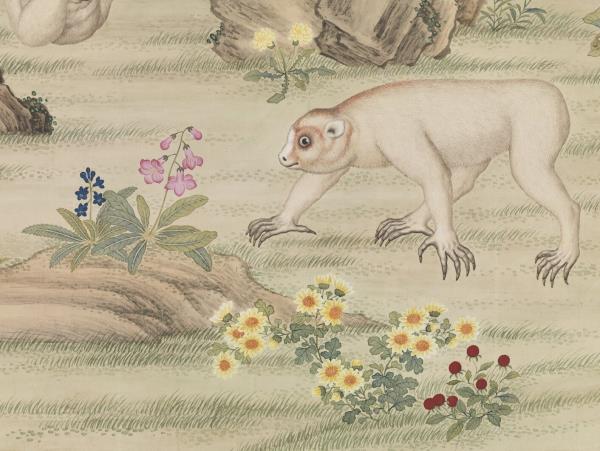
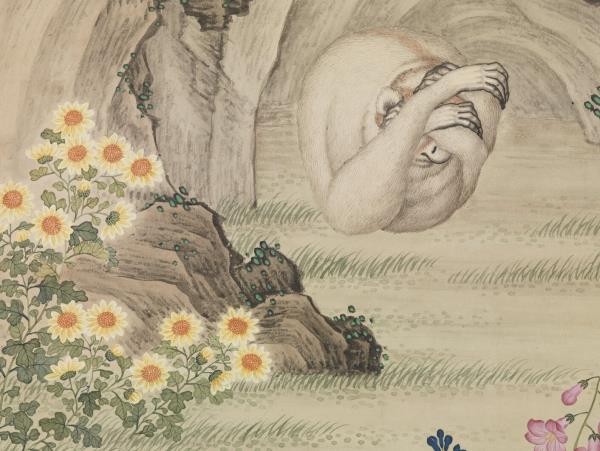
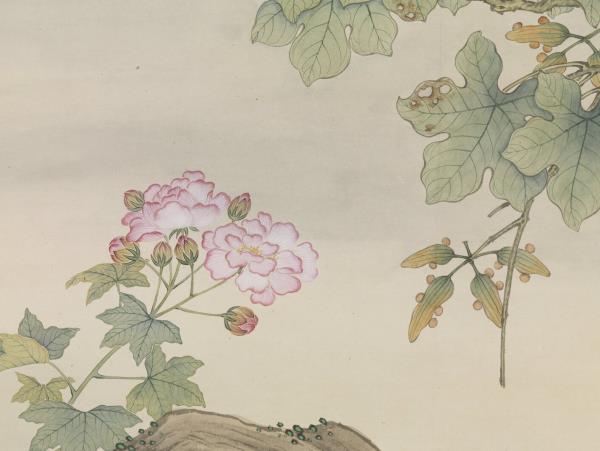
山徑之末,纍石成穴,梧桐、丹桂、芙蓉,雜以野菊秋卉,風猩二,一蜷伏洞中,一逡巡洞口。筆墨遒細而秀潤,設色雅淡而清麗,與鄒一桂蔣廷錫筆畫有契合處,為艾氏精心之作。
|
| 內容簡介 |
艾啟蒙(西元一七0八-一七八0年),波西米亞人。乾隆十年(西元一七四五年)入如意館,與朗世寧、王致誠同為畫院供奉。
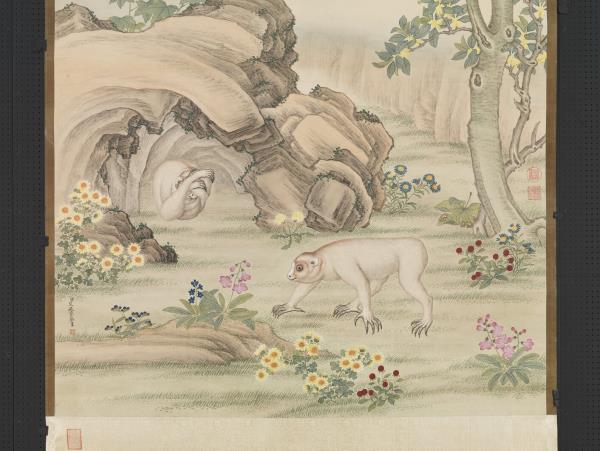
山俓之末,疊石城穴,梧桐、丹桂、芙蓉、雜以野菊秋卉,風猩二,一蜷伏洞中,一巡於洞口。經過專家比對,這稱為「風猩」的動物可能是一種分布於雲南或廣西南部的原始的猴類,又稱為蜂猴或懶猴。
|
| 內容簡介 |
艾啟蒙為波西米亞(今捷克)人,乾隆十年(1745)來華以畫藝服務宮廷。四十二年(1777)曾以七十歲生日獲乾隆皇帝賞賜禮物,是郎世寧之後最重要的清宮西洋畫家。艾啟蒙畫風雖與郎世寧同為寫實傾向,畫技卻略遜一些。風猩為一種懶猴,多產於中國西南地區,眼睛圓大、耳朵小時而隱在毛下,有發達的手指,利於攀爬樹枝,以活動遲緩得名。
|
| Description |
Ignatius Sichelbart was originally from Bohemia (in modern Czechoslovakia), arriving in China in 1745 and entering the service of the Ch’ing court as a painter. To celebrate his seventieth birthday, he even received a gift from the Ch’ien-lung Emperor (r. 1736-1795) in 1777. He was the most important Western artist at the Ch’ing court after Giuseppe Castiglione (1688-1766). Although Sichelbart’s painting style is similar to that of Castiglione in terms of the tendency towards realism, his technique was slightly inferior. Depicted in this painting is a loris, which can be found in southwestern China. The slow loris features large eyes and small ears hidden among its fur. It has well-developed fingernails for climbing trees and is noted for its slow movement, hence the name.
|
| Description |
Ignatius Sichelbart was a Bohemian who entered the Ju-i Hall in 1745 and worked with Giuseppe Castiglione and Jean Denis Attiret as painters at the Ch’ing court.
At the end of a mountain path, piles of rocks form a cave opening. The surroundings are interspersed with wild chrysanthemums among firmiana, osmanthus, and hibiscus plants. The two animals that appear here are known as a “slow loris”.One is curled up in the cave and the other is at the entrance.
According to experts, this type of animal is a kind of primitive primate found in the more tropical parts of China. It is also known by the Latin name Nycticebus coucang.
|
| Description |
Ignace Sichelbart, known in China as Ai ch’i-meng, was a native of Bohemia. He entered the Ju-i kuan in 1745, where he served in the Imperial Painting Academy with Giuseppe Castiglione (Lang Shih-ning).
In this painting firmiana, cinnamon and wild chrysanthemums are clustered around the mouth of a cave situated at the end of a mountain path. Curled in a ball, one lemur crouches within the cave while the other prowls nearby. The brushwork is fine, strong and elegant and the use of color displays beautiful restraint. The painting is similar in places to fine-line style of Sichelbart’s Chinese contemporaries, Tsou I-kuei and Chiang T’ing-hsi.
|
| 收藏著錄 |
石渠寶笈續編(養心殿),第三冊,頁1270
|
| 收藏著錄 |
故宮書畫錄(卷八),第四冊,頁131
|
| 收藏著錄 |
故宮書畫圖錄,第十四冊,頁105-106
|
| 參考書目 |
1.王耀庭、陳韻如,〈清艾啟蒙畫風猩〉,收入王耀庭主編,《新視界 : 郎世寧與清宮西洋風》(臺北:國立故宮博物院,2007年初版),頁130-131。
|
本院文物保存維護依〈國立故宮博物院典藏文物管理作業要點〉及〈國立故宮博物院文物修護業務作業原則〉辦理
抽盤點紀錄
修護紀錄