| 文物統一編號 |
故畫001206N000000000
more
故畫001206N000000A01
故畫001206N000000A02
故畫001206N000000B01
故畫001206N000000B02
|
| 作品號 |
故畫00120600000 |
| 品名 |
清吳歷橅宋元人山水 冊
|
| 分類 |
繪畫 |
| 作者 |
吳歷 |
| 數量 |
一冊:十四開(本幅十開十幅,前幅葉二開二幅,後副葉二開二幅) |
| 位置 |
尺寸(公分) |
| 本幅 |
39.7x26.8 |
| 後副葉一 |
39.7x26.8 |
| 前副葉 |
45.5x61.4 |
| 後副葉二 |
47.8x32.3 |
| 題跋類別 |
作者 |
位置 |
款識 |
書體 |
全文 |
| 題跋 |
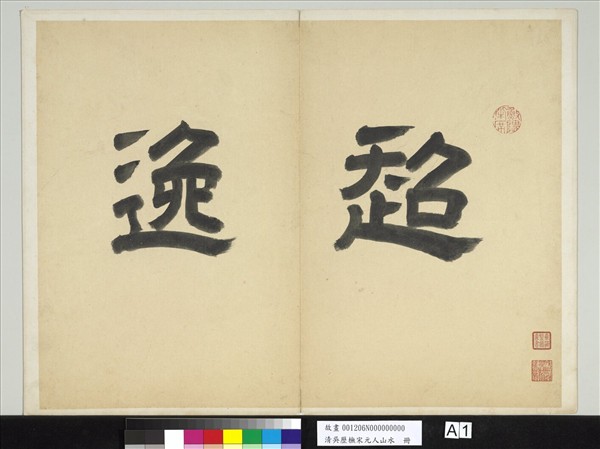
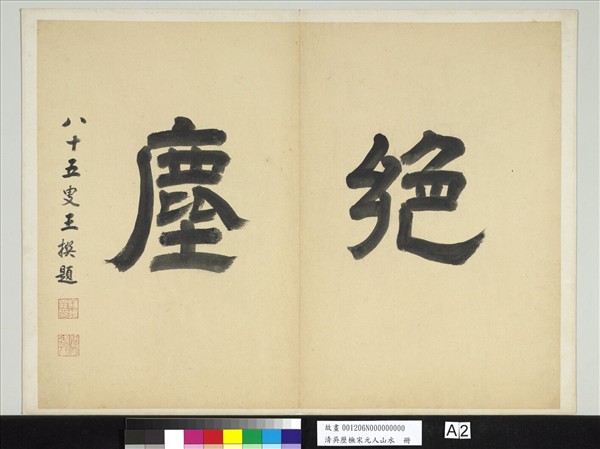
王撰
印記 expand_more
|
前副葉 |
八十五叟王撰題 |
隸書 |
超逸絕塵 |
| 印主 |
印記 |
| 王撰 |
王撰異公 |
| 王撰 |
隨菴老人 |
| 王撰 |
䰻隈半席 |
|
| 題跋 |
王撰
印記 expand_more
|
後副葉一 |
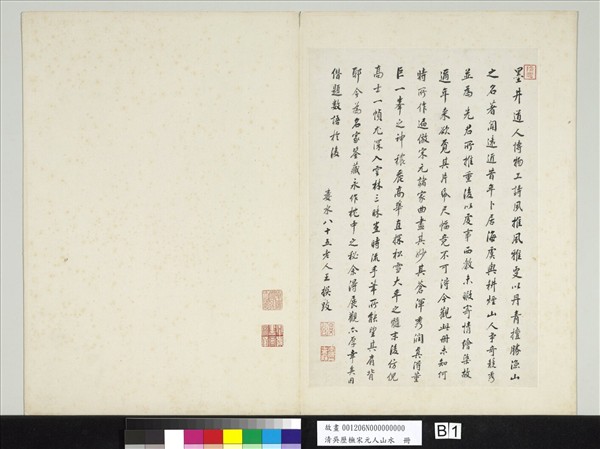
婁水八十五老人王撰跋 |
|
墨井道人。博物工詩。夙推風雅。更以丹青擅勝。漁山之名。著聞遠近。昔年卜居海虞。與耕煙山人。爭奇競秀。并為先君所推重。後以虔事西教。未暇寄情繪染。故邇年來欲覓其片紙尺幅。竟不可得。今觀此冊。未知何時所作。遍倣宋元諸家。曲盡其妙。其蒼渾秀潤。真得董巨一峰之神。穠麗高華。直探松雪大年之髓。末後仿倪高士一幀。尤深入雲林三昧。豈時流手筆所能望其肩背耶。今為名家鑑藏。永作枕中之祕。余得展觀亦厚幸矣。因僭題數語於後。婁水八十五老人王撰跋。 |
| 印主 |
印記 |
| 王撰 |
異公氏 |
| 王撰 |
太原八十五翁 |
| 王撰 |
隨庵 |
|
| 題跋 |
王撰
印記 expand_more
|
後副葉二 |
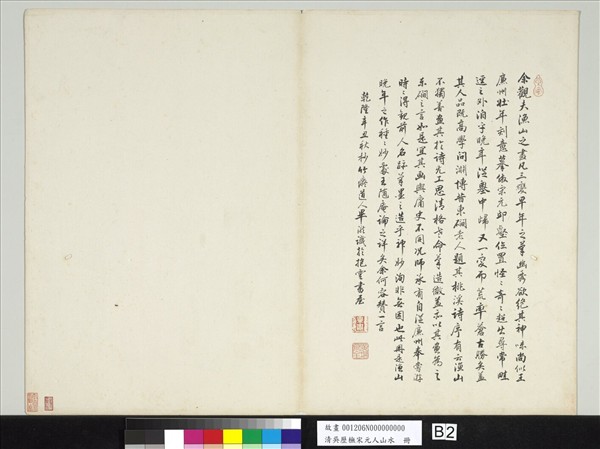
乾隆辛丑秋杪竹癡道人畢瀧識於抱雲書屋 |
|
余觀夫漁山之畫凡三變。早年之筆幽秀欲絕。其神味尚似王廉州。壯年刻意摹倣宋元。邱壑位置。怪怪奇奇。超出尋常畦逕之外。洎乎晚年。從墺中歸又一變。而荒率蒼古勝矣。蓋其人品既高。學問淵博。昔東磵老人題其桃溪詩序有云。漁山不獨善畫。其於詩尤工。思清格老。命筆造微。蓋亦以其畫為之。東磵之言如是。宜其畫與庸史不同。況師承有自。從廉州奉嘗遊。時時得觀前人名跡。筆墨之造乎神妙。洵非無因也。此冊是漁山晚年之作。種種妙處。王隨庵論之詳矣。余何容贊一言。乾隆辛丑秋杪竹癡道人畢瀧識於抱雲書屋。 |
| 印主 |
印記 |
| 畢瀧 |
畢瀧 |
| 畢瀧 |
廣堪齋主 |
| 畢瀧 |
巢安 |
|
| 題跋 |
畢瀧 |
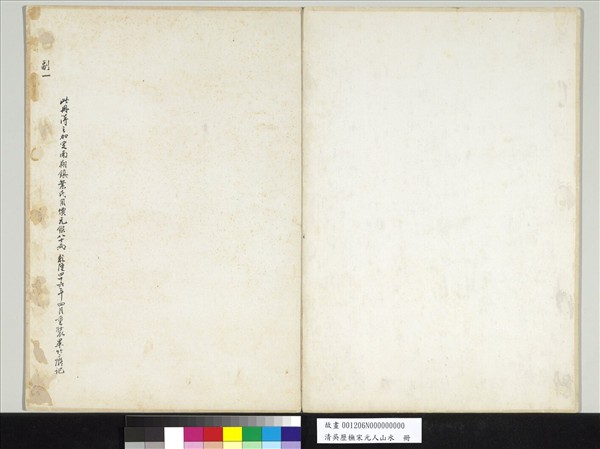
前副葉(後背) |
乾隆四十六年四月重裝畢竹癡記 |
|
此冊得之加定南翔鎮葉氏用價元銀八十兩乾隆四十六年四月重裝畢竹癡記。 |
| 印記類別 |
印主 |
印記 |
| 收傳印記 |
畢瀧 |
畢瀧書畫圖章 |
| 收傳印記 |
畢瀧 |
畢瀧澗飛氏藏 |
| 收傳印記 |
畢瀧 |
畢瀧鑑藏圖書 |
| 收傳印記 |
畢瀧 |
就蘭主人鑑藏 |
| 鑑藏寶璽 |
清仁宗 |
嘉慶御覽之寶 |
| 類別 |
參考資料 |
| 內容簡介 |
吳歷(西元一六三二-一七一八年),江蘇常熟人,字漁山,號墨井道人。擅長繪畫,與王翬同受業於王鑑、王時敏,為清初六家之一。惟因壯年後,信奉天主虔誠,熱心傳教工作,疏於繪畫,作品傳世甚少。本冊題名「橅宋元人山水」,這是清代初期畫壇主要的風氣之一。吳歷期望從宋元等前輩名家的作品,集合出眾家長處。全冊十開未署年月,據畢瀧(活動於十八世紀)跋,謂是晚年從澳門歸後所作。乾隆時畢瀧用銀八十兩購藏,嘉慶時始進宮。
|
| 內容簡介 |
山水畫歷經宋元兩朝,累積了豐富優良的傳統,融合各家各派的長處,正是清朝初期畫家所要追求學習的,這樣的風格,在表面上看來,某幅畫學自某人,非常的清楚,甚至畫壇有「人人一峰﹙元、黃公望,一二六九-一三五四﹚家家山樵﹙元、王蒙,一三0八-一三八五﹚」的現象,而被認為是泯滅藝術最重要的個性創造。然而,卻不能如此單純的評論,毋寧說是清初畫家以較含蓄的方式,透過古人來表達自己。欣賞本冊的前提應有如是的觀念。本冊共十幅,第一幅青綠設色,用筆用墨均溫文柔雅,追摹的對象是元代趙孟頫﹙一二五四-一三二二﹚的風格。第二幅、第七幅山勢崢嶸,石骨崚嶒,山之四面斬絕,而少林木,一派河溯山岳氣象,正是五代荊浩、關仝﹙均活動於十世紀﹚一系的作風。第四幅,主山堂堂,巨峰頂立,來自北宋范寬﹙活動於十一世紀﹚一系的面貌,皴法用麻披,又融會了巨然的作風。第三幅畫的是江南水鄉,楊柳依依,小艇往來,漁翁牽罟。第五幅,畫的也是江南水鄉,岸邊孤舟獨泊,綠波間,荷香飄蕩,鸕鶿成群,晴空中,雁行陣陣。這兩幅,空靈疏朗,得之於趙令穰﹙活動於十一世紀﹚。第六幅,青山在望,白雲湧起,古寺叢林,掩映其中,小橋流水,村舍臨水建築,筆法上用點,應是得之於米芾﹙一0五一-一一0七﹚雲山。第八幅,臨江微傾的巨巖,岸邊泊一舟,船頭白衣人,神態悠然,似是來此懷古。吳歷擅青綠設色,但不因色勝而減筆墨之趣,恰如第一幅,山顛水涯,施綠布丹,自然界彩色之妙,全然出現筆下,而水際空明,布景偏於角落,取徑於南宋人。第九幅之布局及筆法大致出於黃公望。第十幅,一河兩岸,則來自倪瓚﹙一三0一-一三七四﹚。兩幅淡墨滃染,柔秀韻味,正是元朝人特色。全冊雖學自各家,但是整體用筆、用墨、設色仍然非常一貫。一股雅淡的意味,也正是吳歷個人的特色。
|
| Description |
Landscape painting, having evolved through the Sung and Yuan dynasties, developed into a rich tradition which incorporated the various strengths of past schools. Artists of the early Ch’ing dynasty especially pursued the study of ancient masters, and references to them were clearly recognizable. There even emerged the phenomenon of everyone studying the Yuan masters Huang Kung-wang (1269-1354) and Wang Meng (1308-1385). This practice was acknowledged as having stifled individual creativity. However, such an evaluation of Ch’ing painting is rather simple, and, in fact, it should be noted that early Ch’ing dynasty painters used the subtle method of expressing themselves through the ancient masters. There are ten leaves in this album. This first leaf, executed in ink with mineral blue and green pigments, is in the style of the Yuan artist Chao Meng-fu (1254-1322). The brushwork and ink quality is refined and elegant. In the second and seventh leaves, the styles of Ching Hao and Kuan T’ung (act. ca. 10th cent.) are emulated. The mountains are extremely precipitous with steep rocks, and the trees are sparse. The entire scene gives an impression of vast mountains and rivers.
|
| Description |
In the fourth leaf, the monumental mountain with its towering peak is derived from the northern Sung artist Fan K’uan (act. ca. 11th cent.). The hemp-fiber strokes used to give texture to the mountains are a reference to Chu-jan’s style. A water village of the Kiangnan region is depicted in the third leaf. Willows sway, a long narrow boat drifts by, and a fisherman works a fishing net. The fifth leaf is also a scene of a water village in Kiangnan. A lone, empty boat is moored by the bank and lolls between the waves. The fragrance of lotuses seems to drift along, pervading the scene. Cormorants congregate into a flock on the water, and wild geese fly in a v-formation in the cloudless sky. These two leaves, characterized by the spacious and clear atmosphere, were inspired by Chao Ling-jang (act. ca. 11th cent.). In the sixth leaf, white clouds rise up from the mountains. An ancient temple is hidden within the lush forest, and a small bridge spans a stream, beside which the village houses were built.
|
| Description |
The brushwork is composed of many dots, inspired by Mi Fu’s (1050-1107) brushwork in his Cloudy Mountains. In the eighth leaf, Wu Li has depicted a huge rock cliff leaning over the river. A figure wearing white clothing sits in the bow of the boat moored by the bank. He seems lost in meditation as though he came here to reminisce about the past. Wu Li has used blue-green pigments, but the color has not overpowered the beauty of his ink and brushwork. This is very similar to the first leaf. The mountains and water have been painted with touches of green and cinnabar. The colors of nature all appear in this painting. This composition, concentrated in one corner, is derived from southern Sung (1127-1279) artists. In the ninth leaf, the composition and brushwork basically follow that of Huang Kung-wang, while the style and composition of the tenth leaf composed of two banks and a river originated with Ni Tsan (1301-1374). The pale ink and gentle, elegant rhythm in these leaves are characteristics of Yuan dynasty artists. Although Wu Li painted this album after different masters, it is evident that the brushwork and use of ink and color are very much by one hand. The elegant and refined air in the album reflects Wu Li’s own style.
|
| Description |
Wu Li, style name Yu-shan, sobriquet Mo-ching tao-jen, was a native of Ch’ang-shu, Kiangsu province. He excelled in painting and with Wang Hui studied under Wang Chien and Wang Shih-min. He is known as one of the six great painters of the Ch’ing dynasty. There are very few of his works because in his middle age he became a devout Catholic and fervently took up missionary work, thus painting less frequently. This album, Landscapes after Sung and Yuan Masters, represents one of the main stylistic trends in early Ch’ing painting. Wu Li’s hope was to assemble the various strengths of Sung and Yuan masters. The album consists of ten leaves. The inscription carries no date, but according to the colophon by Pi Lung (act. ca. 18th cent.), this is a late work executed after Wu Li returned from Macao. Pi Lung recorded that during the Ch’ien-lung period (1736-1796) he purchased the work for 80 liangs of silver. The album did not become part of the Imperial Palace Collection until the Chia-ch’ing period (1796-1821).
|
| 收藏著錄 |
故宮書畫錄(卷六),第四冊,頁143-145
|
| 收藏著錄 |
故宮書畫圖錄,第二十三冊,頁378-381
|
| 參考書目 |
1.馬晉封,〈清吳歷橅宋元十家山水冊一十之一〉,《故宮文物月刊》,第40期(1986年7月),頁122-123 。
2.馬晉封,〈清吳歷橅宋元十家山水冊一十之二〉,《故宮文物月刊》,第41期(1986年8月),頁98-99。
3.馬晉封,〈清吳歷橅宋元十家山水冊一十之三〉,《故宮文物月刊》,第42期(1986年9月),頁72-73。
4.馬晉封,〈清吳歷橅宋元十家山水冊一十之四〉,《故宮文物月刊》,第43期(1986年10月),頁134-135。
5.馬晉封,〈清吳歷橅宋元十家山水冊一十之五〉,《故宮文物月刊》,第44期(1986年11月),頁32-33。
6.馬晉封,〈清吳歷橅宋元十家山水冊一十之六〉,《故宮文物月刊》,第45期(1986年12月),頁78-79。
7.馬晉封,〈清吳歷橅宋元十家山水冊一十之七〉,《故宮文物月刊》,第46期(1987年1月),頁74-75。
8.馬晉封,〈清吳歷橅宋元十家山水冊一十之八〉,《故宮文物月刊》,第47期(1987年2月),頁36-37。
9.馬晉封,〈清吳歷橅宋元十家山水冊一十之九、十〉,《故宮文物月刊》,第48期(1987年3月),頁90-92。
10.馬晉封,〈清吳歷橅宋元十家山水冊一十之九、十〉,《故宮文物月刊》,第48期(1987年3月),頁90-92。
|
本院文物保存維護依〈國立故宮博物院典藏文物管理作業要點〉及〈國立故宮博物院文物修護業務作業原則〉辦理
抽盤點紀錄
修護紀錄