| 文物統一編號 |
故畫001173N000000000
more
故畫001173N000000B01
|
| 作品號 |
故畫00117300000 |
| 品名 |
清查士標書畫合璧 冊
|
| 分類 |
繪畫 |
| 作者 |
查士標 |
| 數量 |
一冊:九開(本幅八開十六幅,後副葉一開一幅) |
| 作品語文 |
漢文 |
| 位置 |
尺寸(公分) |
| 本幅 |
17.5x12.4 |
| 後副葉 |
19.2x28 |
| 題跋類別 |
作者 |
位置 |
款識 |
書體 |
全文 |
| 題跋 |
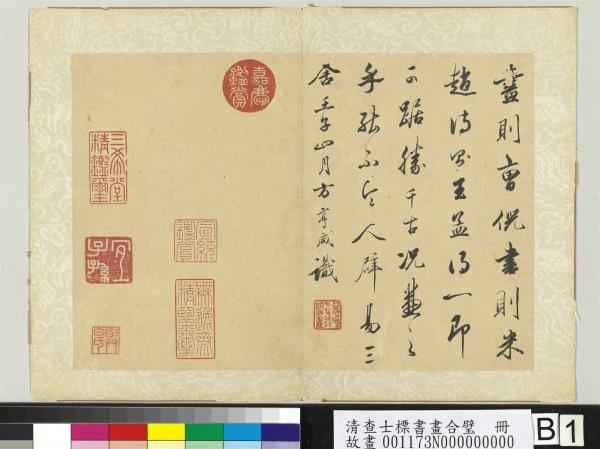
方亨咸
印記 expand_more
|
後副葉 |
壬子四月。方亨咸識。 |
草書 |
畫則曹倪。書則米趙。詩則王孟。得一即可踞勝千古。況兼之乎。能不令人辟易三舍。壬子四月。方亨咸識。 |
|
|
| 印記類別 |
印主 |
印記 |
| 收傳印記 |
方亨咸 |
松下清齋 |
| 收傳印記 |
方亨咸 |
與白氏 |
| 鑑藏寶璽 |
清內府印 |
三希堂精鑑璽 |
| 鑑藏寶璽 |
清內府印 |
石渠寶笈 |
| 鑑藏寶璽 |
清內府印 |
宜子孫 |
| 鑑藏寶璽 |
宣統帝 |
宣統御覽之寶 |
| 鑑藏寶璽 |
宣統帝 |
宣統鑑賞 |
| 鑑藏寶璽 |
宣統帝 |
無逸齋精鑒璽 |
| 鑑藏寶璽 |
清仁宗 |
嘉慶御覽之寶 |
| 鑑藏寶璽 |
清仁宗 |
嘉慶鑑賞 |
| 鑑藏寶璽 |
清仁宗 |
寶璽三編 |
| 類別 |
參考資料 |
| 內容簡介 |
查士標(西元一六一五-一六九八年),字二瞻,號梅壑。安徽休寧人,流寓江蘇揚州。明朝亡後,棄科舉專事書畫。家中收藏古器物、宋元書畫頗豐,並精鑑別。書學米芾,卻似董其昌;畫初學倪瓚,後參吳鎮。文人畫當道,以詩畫呈現,本冊所見,畫中景致,正如詩文所描述。看畫讀詩,詩引畫意,畫呈詩境,倍覺一股出塵不染的意味。畫中單用墨筆,且以枯墨為多,畫景正與後世評其畫之「用筆不多,丰神荒寒」侔合。書法學董其昌,行間筆調清雅,與畫中情境頗為相稱。
|
| 內容簡介 |
釋文:僊樓高峙隱晴暉。鹿過幽溪覓紫芝。洞裡不同城市色。花開如錦草離離。士標
水滿平湖燕子來。夭桃弱柳已胚胎。便操小艇湖頭去。領取春光次第開。查士標。
海岳庵前路。無人認舊蹤。朝來新雨過。天外秀芙蓉。查士標。
今年秋較晚。木葉未全凋。莫負新晴好。閑來度小橋。士標。
山光雨後潤。樹杪響層泉。墨花鮮欲滴。此意道人傳。士標題。
春暖桃溪綠。風翻柳浪茸。小舟隨去住。鼓枻意無窮。士標。
江天秋水長。欲雨似瀟湘。雁落征帆遠。青山是岳陽。查士標。
亂石岡頭黃葉稀。西風驢背夕陽微。聯吟不覺歸來晚。及至吟成又不歸。士標畫邵邨先生詩意。
|
| Description |
Album of Painting and Calligraphy
Cha Shih-piao (1615-1698)
Ch’ing Dynasty
Cha Shih-piao (style name Erh-chan and sobriquet Mei-huo) was a native of Hsiu-ning, Anhwei, who resided in Yangchow, Kiangsu. After the fall of the Ming dynasty in 1644, he gave up hope of passing the civil service examinations and focused on painting and calligraphy instead. His family had a rich collection of antiquities, including Sung and Yuan painting and calligraphy, which he studied to cultivate his connoisseurship skills. In calligraphy, he studied the style of Mi Fu (1052-1107) to create a manner similar to that of Tung Ch’i-ch’ang (1555-1636). In his early paintings, he followed the style of Ni Tsan (1301-1374), later studying that of Wu Chen (1280-1354).
In the scholar painting of Cha Shih-piao’s time, both painting and poetry were often combined together, as seen in this album. The paintings here depict marvelous scenery, just as described in the poetry and prose. Viewing the paintings and reading the poems, they complement and enhance each other’s qualities to cultivate an atmosphere of unspoiled refinement and elegant purity. Only ink was used in these paintings, often appearing slightly dry and scorched. These landscapes fit later descriptions of his paintings as having “Limited brushwork and a desolate atmosphere.” The style of the calligraphy here follows in the tradition of Tung Ch’i-ch’ang (1555-1636) with the brushwork and spacing being rhythmic and elegant. Here, they form an ideal complement to the painting.
|
| 收藏著錄 |
石渠寶笈三編(延春閣),第五冊,頁2148
|
| 收藏著錄 |
故宮書畫錄(卷六),第三冊,頁103
|
| 收藏著錄 |
故宮書畫圖錄,第二十三冊,頁294-297
|
本院文物保存維護依〈國立故宮博物院典藏文物管理作業要點〉及〈國立故宮博物院文物修護業務作業原則〉辦理
抽盤點紀錄
修護紀錄