| 文物統一編號 |
贈畫000118N000000000
|
| 作品號 |
贈畫00011800000 |
| 品名 |
清朱耷東坡朝雲圖 軸
Dongpo and Chaoyun |
| 分類 |
繪畫 |
| 作者 |
朱耷 |
| 數量 |
一軸 |
| 位置 |
尺寸(公分) |
| 全幅 |
132.4 |
| 本幅 |
89.2x126.8 |
| 題跋類別 |
作者 |
位置 |
款識 |
書體 |
全文 |
| 題跋 |
朱耷
印記 expand_more
|
本幅 |
|
行書 |
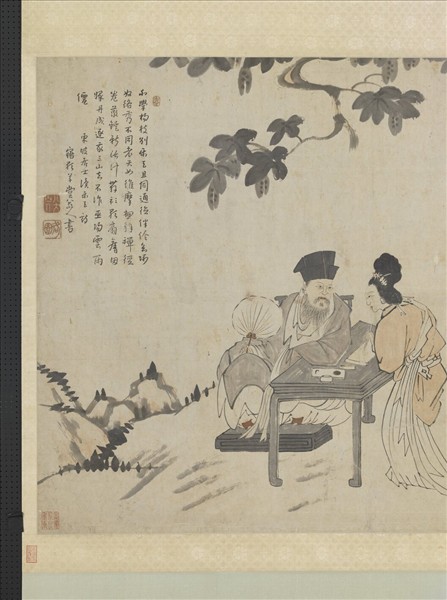
不學楊枝別樂天。且同通德伴伶玄。阿奴絡秀不同老。天女維摩總解禪。經卷藥罏新活計。舞衫歌扇舊因緣。丹成逐我三山去。不作巫陽雲雨僊。東坡居士讀樂天詩。寤歌草堂八大山人書。 |
| 印主 |
印記 |
| 朱耷 |
八大山人 |
| 朱耷 |
何園 |
| 朱耷 |
十得 |
| 朱耷 |
真賞 |
|
| 印記類別 |
印主 |
印記 |
| 收傳印記 |
張岳軍 |
岳軍鑑藏畫畫 |
| 主題類別 |
主題(第一層) |
主題(第二層) |
主題說明 |
| 主要主題 |
人物 |
仕女 |
仕女(王朝雲) |
| 主要主題 |
人物 |
高士(士人、隱士) |
士人(蘇軾) |
| 次要主題 |
樹木 |
梧桐 |
|
| 其他主題 |
器用 |
文房用具 |
|
| 其他主題 |
器用 |
扇 |
|
| 其他主題 |
器用 |
傢俱(屏風) |
桌、腳踏、椅 |
| 其他主題 |
樹木 |
|
|
| 其他主題 |
樹木 |
竹 |
|
| 類別 |
參考資料 |
| 內容簡介 |
朱耷(西元一六二六—一七○五年),江西人。明宗室,甲申後為僧,號八大山人,又號雪個、人屋。能詩工書,擅山水、花鳥、竹石,筆意縱恣,不泥成法。所題「八大山人」四字,多聯綴成似「哭之」或「笑之」,蓋別有用意。與弘仁、石谿、石濤俗稱「四僧」。
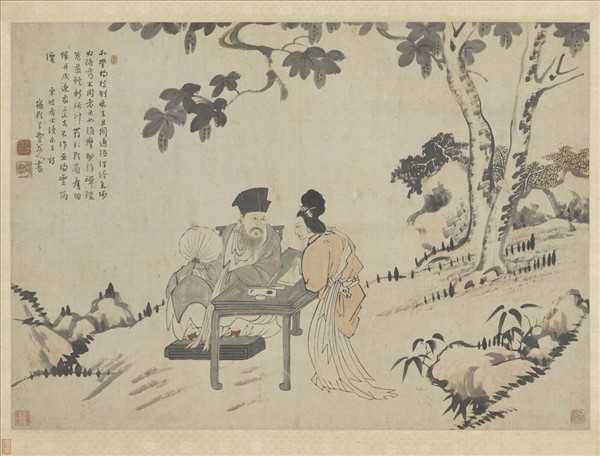
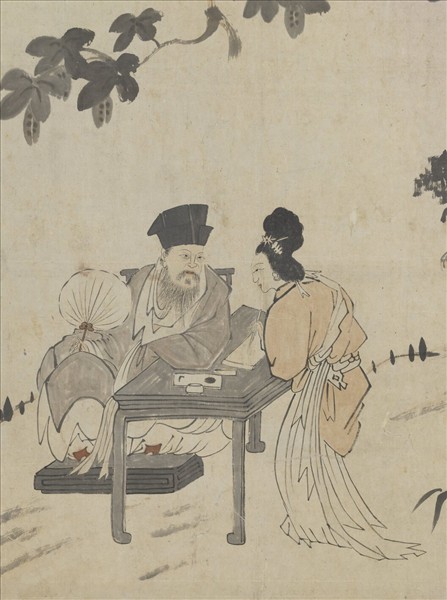
設色繪東坡做桐蔭,目視朝雲作書。按:朝雲姓王,為錢塘名妓。蘇軾官錢塘時,納為常侍。初不識字,事軾後始學書,後軾貶惠州,家奴皆散去,獨朝雲相依。
|
| 內容簡介 |
朱耷(1626-1705),江西人。明宗室,甲申後為僧,號八大山人,又號雪個、人屋。能詩工書,擅山水、花鳥、竹石,筆意縱恣,不泥成法;與弘仁、石谿、石濤俗稱「四僧」。
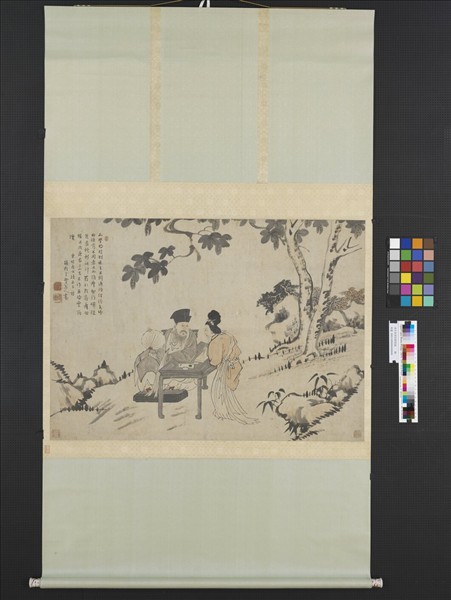
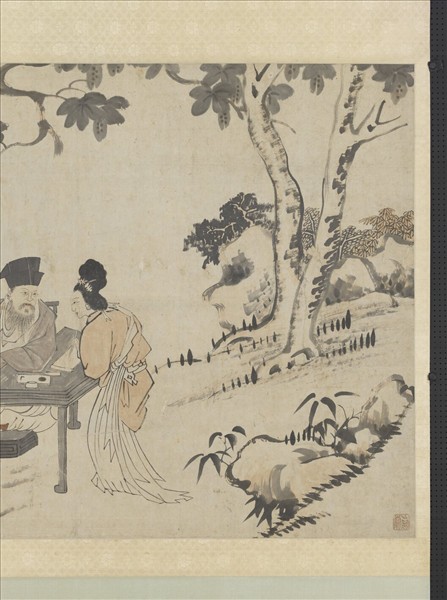
此幅畫的是庭園一角,梧桐二株,蘇東坡手持團扇,坐在太師椅上,身體斜靠桌案,雙目注視著身軀微屈提筆書寫的朝雲。蘇軾官錢塘時,納錢塘名妓-朝雲為常侍。初不識字,事軾後始學書,後軾貶惠州,家奴皆散去,獨朝雲相依。
張群先生捐贈於民國67年。(20110204)
|
| Description |
Zhu Da, a native of Jiangxi, was a scion of the Ming dynasty imperial family. After the fall of the Ming, he took the tonsure and became a monk, adopting the sobriquet Bada shanren as well as Xuege and Renwu. He excelled at landscape, bird-and-flower, and bamboo-and-stone painting, his brushwork free and easy without the restraints of conventional methods. Along with Hongren, Shixi (Kuncan), and Shitao, he is commonly referred to as one of the “Four Monk-Painters” of the late Ming and early Qing.
This painting depicts the corner of a garden with two paulownia trees and the great Northern Song poet-calligrapher and official Su Shi (Dongpo) sitting with a round fan in a chair as he leans on a table, his eyes fixed on Chaoyun, who leans over with brush to write. When Su Dongpo was an official in Qiantang, he took in Chaoyun, a famous courtesan there, as his attendant. Though illiterate at first, Chaoyun in Su’s service began to learn calligraphy. Later when Su was banished even further to Huizhou, all his servants left him, except for Chaoyun.
Mr. Chang Chun donated this work to the National Palace Museum in 1978.(20110204)
|
| Description |
Chu Ta,a scion of the Ming dynasty royal family, was a native of Kiangsi province. With the fall of the Ming dynasty in 1644, he became a monk and took the sobriquets Pa-ta shan-jen, Hsueh-ko, and Jen-wu. He was skilled at composing poetry and writing calligraphy, and he especially excelled in painting landscapes, birds and flowers, and bamboo and rocks. He gave full vent to the expressiveness of his brush and was not constrained by rules. He wrote his signature, “Pa-ta shan-jen,” in such a way that at the same time it looks like the characters “to laugh” and “to cry.” Chu Ta is considered one of the Four Monk painters of the late Ming-early Ch’ing along with Hung-jen, K’un-ts’an, and Shih-t’ao.
In this painting, Su Tung-p’o, sitting in the shade of a paulownia tree, looks at Ch’ao-yun as she writes. Ch’ao-yun, surnamed Wang, was a famous courtesan from Hangchou. When Su Tung-p’o was an official in Hangchou, Ch’ao-yun of-ten served him. At first, she was illiterate, but after she served him for a while, she began to study. When Su Tung-p’o returned to Hui-chou, all his servants left him except for Ch’ao-yun.
This painting was donated by Madame Lo Chih-hsi.
|
| 參考書目 |
何炎泉,〈清朱耷東坡朝雲圖 軸〉,收入劉芳如主編《她-女性形象與才藝》(臺北:國立故宮博物院,2020.10),頁122-123、264。
|
| 收藏著錄 |
張岳軍先生王雪艇先生羅志希夫人捐贈書畫特展圖錄,頁7、222
|
本院文物保存維護依〈國立故宮博物院典藏文物管理作業要點〉及〈國立故宮博物院文物修護業務作業原則〉辦理
抽盤點紀錄
修護紀錄