| 文物統一編號 |
贈畫000201N000000000
|
| 作品號 |
贈畫00020100000 |
| 品名 |
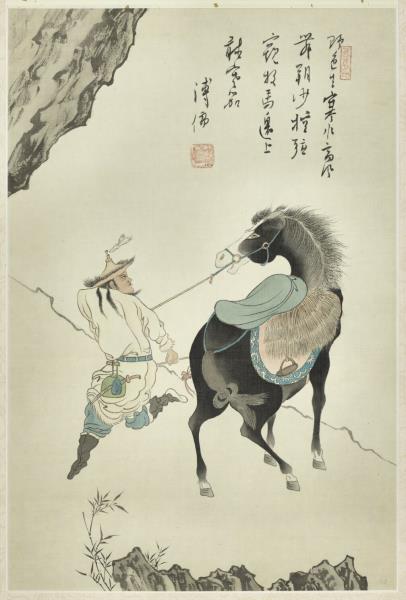
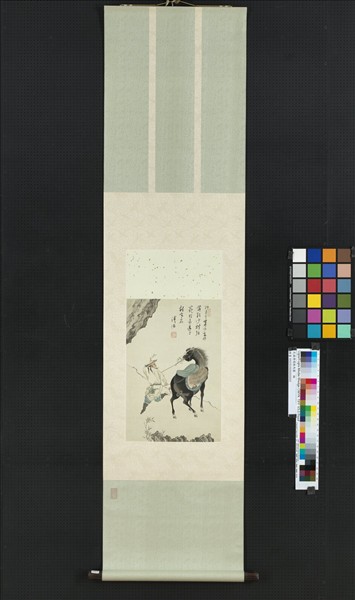
民國溥儒鞍馬圖 軸
Reining the Horse |
| 分類 |
繪畫 |
| 作者 |
溥儒 |
| 數量 |
一軸 |
| 題跋類別 |
作者 |
位置 |
款識 |
書體 |
全文 |
| 作者款識 |
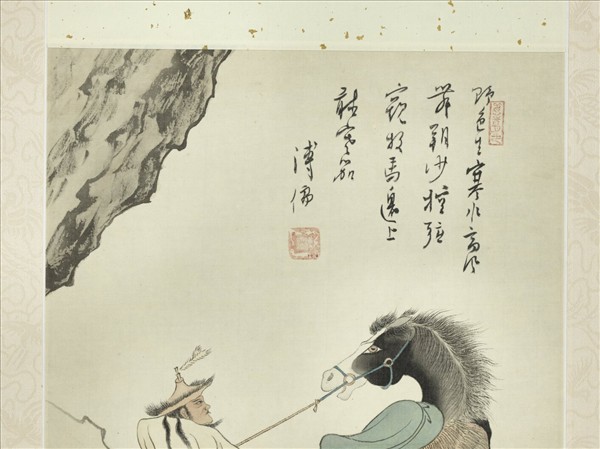
溥心畬
印記 expand_more
|
本幅 |
野色生寒水。高風舞朔沙。控弦窺牧馬。邊上聽寒笳。 |
行草書 |
|
|
|
| 主題類別 |
主題(第一層) |
主題(第二層) |
主題說明 |
| 主要主題 |
人物 |
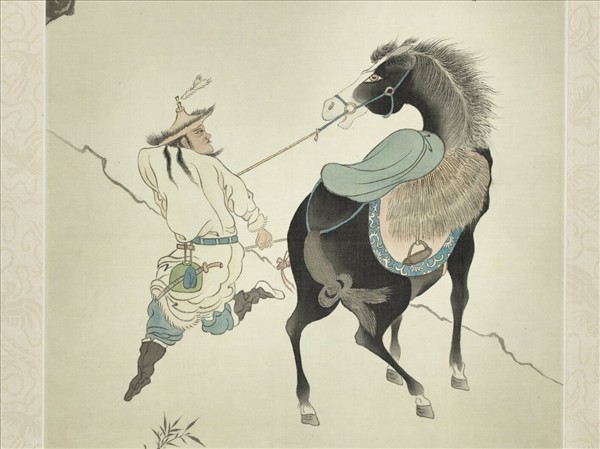
圉人 |
|
| 主要主題 |
走獸 |
馬 |
|
| 其他主題 |
器用 |
馬鞍 |
|
| 類別 |
參考資料 |
| 內容簡介 |
溥心畬先生的畫路寬廣,「鞍馬圖」的題材即是其中之一。畫馬的經驗,一方面來自臨古,一方面則是本身生活的體驗。滿族皇室子弟,向例要求文武雙全,因此騎馬射箭為必須學習。「人馬圖」與「臨唐人奚官調馬圖」出自古人畫本,用細緻而流暢之線條,雖云工整,而落筆運轉頓挫畢見,設色也屬於清靈雅逸,一貫溥氏本色。相對於這兩幅畫的沉靜,「蒙古騎士」畫策馬高崗,背景之山崗巖壁,用筆固然放縱,而人物服飾具邊疆民族特色,然細審其人馬造形,實出於美國描述西部武打牧人電影,這可以說將中外古今,巧妙地溶合表現。
|
| 內容簡介 |
溥儒(西元一八九六-六三年),河北宛平人。字心畬,清宗室,恭親王之後。幼年即究心詩詞、繪事、書法。工山水,喜用熟紙臨摹馬夏一派之作。與張大千有南張北溥之稱。
本幅為溥氏臨仿古人蕃馬圖的作品,他以屬於自己風格的清俊線條,和淡雅的設色,給予古畫另一種清新的風味。
|
| Description |
Saddling the Horse
P’u Ju (1886-1963)
Republican Period
P’u Ju was a scion of the Ch’ing imperial family and was a descendant of the famous Prince Kung. When he was young, he began to study belles-lettres, calligraphy, and painting. He was particularly skilled at landscape painting and was fond of using sized paper, which enables the artist to use different brush techniques. P’u Ju’s style follows the Ma-Hsia school, named for the Southern Sung masters Ma Yuan and Hsia Kuei. Because his fame is comparable to that of his Southern contemporary Chang Ta-ch’ien (1899-1983), they are often referred to as “Southern Chang and Northern P’u.”
In this painting, P’u emulates the manner of an earlier horse painting. However, he still follows the path of his own style. By using pastel colors, he gives the ancient composition a fresh flavor.
|
| Description |
P’u Hsin-yu’s painting is both broad and varied, and depictions of riders and horses is one genre within his oeuvre. In painting horses, P’u Hsin-yu both copied ancient models and learned from his own experiences. The male descendents of the Manchu rulers were required to excel in both literary and military prusuits, so they had to learn to ride a horse and shoot arrows while on horseback. P’u Hsin-yu drew inspiration for Horse and Groom and Groom Taming a Horse from ancient paintings. He used fine and fluid brushlines, painting with extreme care. His brushwork and brush movement as well as his clear and elegant colors reveals his personal style. In contrast, Mongolian Rider, is totally different. A Mongolian rider and horse are depicted in profile on a high outcrop in front of a mountain peak. The brushwork is swift and free, and the rider is dressed in clothing worn by people on the borders of China. Looking closely at the horse and rider, one may surmise that P’u Hsin-yu took as his models the cowboys he saw in American Westerns. In this way, P’u Hsin-yu was able to synthesize both Chinese and Western, ancient and modern idioms.
|
| Description |
Paintings of ladies, according to painting texts, should reveal the gentleness, serenity, and purity of women. Lady by a Plantain Tree and Lady Holding a silk Fan are both depictions of women at leisure in which feminine grace and beauty are extolled. P’u Hsin-yu was able to capture the beauty of women while eschewing overly pretty depictions.
Also among P’u Hsin-yu oeuvre are subjects from popular folk tales and legends. P’u Hsin-yu derived paintings such as Kuan-yu, General Kuan Yu, and Guardian Deity of Students and Scholars from older compositions and invested them with a new vitality through his brushwork. For instance, the flying sashes in Guardian Dity of Students and Scholars are adapted from the “wind-blown scarves of Wu Tap-tzu,” an idiom in figure painting.
P’u Hsin-yu collaborated with Chang Dai-chien in Old Friends Conversing in the Shade of a Pine. Chang Dai-chien painted the figure dressed in a traditional long robe, while P’u Hsin-yu painted the one with a hat. The poem reflects upon the sorrow of having left one’s home country.
|
| 參考書目 |
1.林柏亭、張華芝,〈民國溥儒鞍馬圖〉,收入林柏亭、張華芝編,《畫馬名品特展圖錄》(臺北:國立故宮博物院,1990年元月初版),頁108。
|
| 收藏著錄 |
溥心畬先生書畫特展目錄,頁35、82
|
| 收藏著錄 |
故宮受贈文物選萃,頁93、153
|
本院文物保存維護依〈國立故宮博物院典藏文物管理作業要點〉及〈國立故宮博物院文物修護業務作業原則〉辦理
抽盤點紀錄
修護紀錄