| 文物統一編號 |
贈畫000585N000000000
|
| 作品號 |
贈畫00058500000 |
| 品名 |
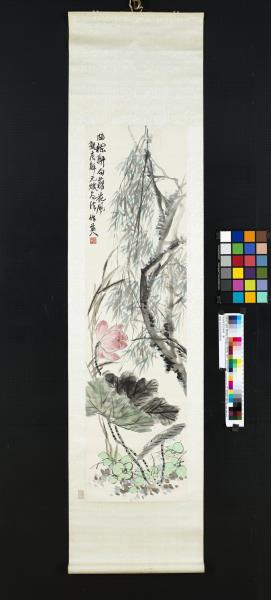
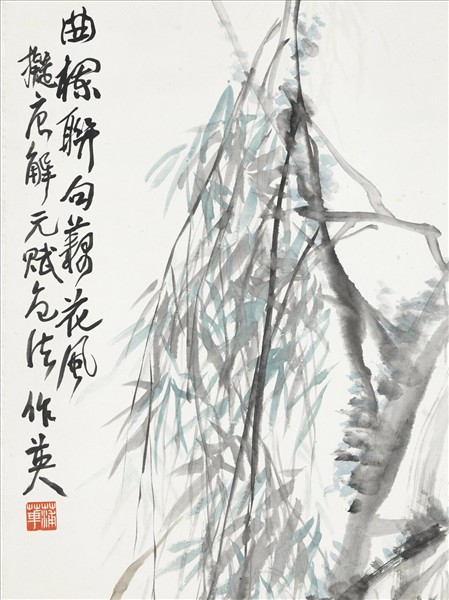
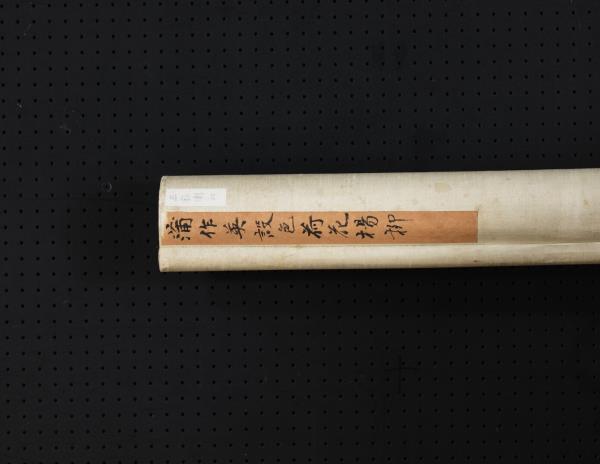
清蒲華荷花楊柳 軸
Lotus and Willow |
| 分類 |
繪畫 |
| 作者 |
蒲華 |
| 數量 |
一軸 |
| 主題類別 |
主題(第一層) |
主題(第二層) |
主題說明 |
| 主要主題 |
花草 |
蓮荷 |
|
| 主要主題 |
樹木 |
楊柳 |
|
| 類別 |
參考資料 |
| 內容簡介 |
蒲華(西元一八三○-一九一一年),秀水(今浙江嘉興)人,僑寓上海。字作英,一署胥山外史,原名成,字竹英。草書自謂效呂洞賓、白玉蟾,筆意奔放。早歲畫花卉,在徐渭、陳淳間。晚乃畫竹,心醉文同。山水樹石,亦淋漓元氣,蓋取法石濤、石谿而加以變化。
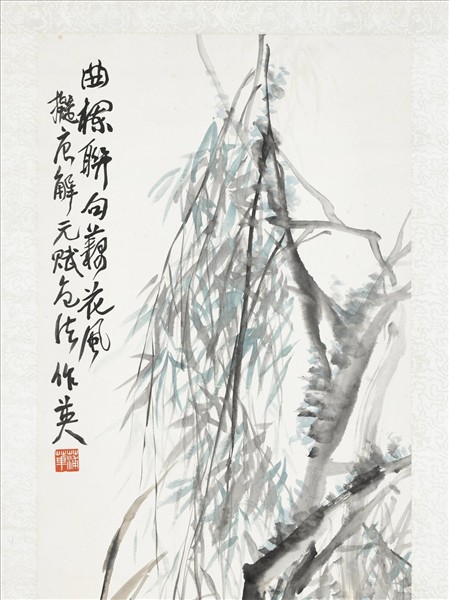
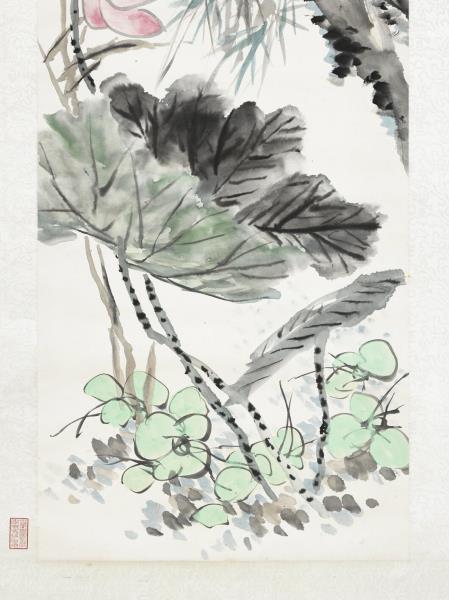
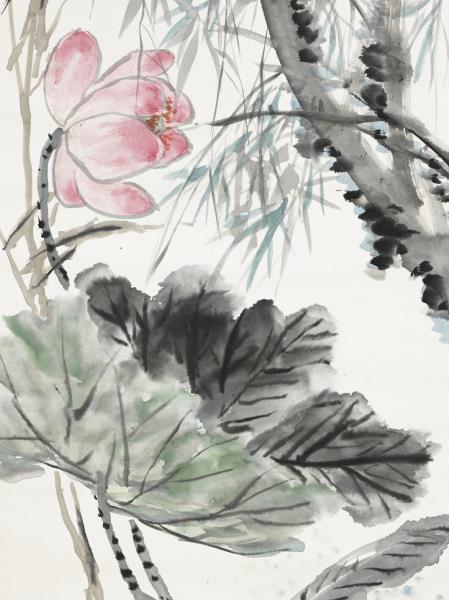
設色畫荷花楊柳。以水墨和花青畫垂柳,妙具風姿飄逸之勢,並以墨和汁綠畫荷葉,紅色染花;其下浮萍則以石綠點染。此幅筆墨活潑,賦色明麗,極具生趣。
本幅為王新衡先生捐贈。
|
| 內容簡介 |
蒲華(西元一八三二-一九一一年),字作英,浙江嘉興人。咸豐三年(一八五三)中秀才。長於花卉墨竹,承襲陳淳、徐渭的寫意花卉。晚年寓上海,以鬻畫自給。
本幅自識仿唐寅賦色法,以水墨花青畫垂柳,水墨汁綠畫荷葉,白粉朱砂染花,石綠染浮萍,形成明暗對比,明豔而不失雅淡。柳枝荷莖運筆靈活,展現飄逸曼妙的姿態。本幅為王新衡先生捐贈。
|
| 內容簡介 |
蒲華(西元一八三○—一九一一年),秀水(今浙江嘉興)人,僑寓上海。字作英,一署胥山外史,原名成,字竹英。咸豐三年(一八五三)秀才。上承陳淳、徐渭的寫意花卉傳統,尤擅花卉、墨竹。晚年寓上海,以鬻畫自給。
本幅為王新衡先生捐贈。自識仿唐寅賦色法,以水墨和花青畫垂柳,妙具風姿飄逸之勢,並以墨和汁綠畫荷葉,白粉朱砂染花,石綠染浮萍,形成明暗對比,明豔而不失雅淡。通幅運筆靈活,賦色明麗,極具生趣。
|
| 內容簡介 |
蒲華(1830-1911),秀水(今浙江嘉興)人,僑寓上海。字作英,一署胥山外史,原名成,字竹英。咸豐三年(1853)秀才。上承陳淳、徐渭的寫意花卉傳統,尤擅花卉、墨竹。晚年寓上海,以鬻畫自給。
本幅自識仿唐寅賦色法,以水墨和花青畫垂柳,並以墨和汁綠畫荷葉,白粉朱砂染花,石綠染浮萍,形成明暗對比,明豔而不失雅淡。通幅運筆靈活,賦色明麗,極具生趣。
王新衡先生捐贈於民國77年。(20110204)
|
| Description |
Pu Hua (style names Zuoying and Zhuying; also known as Xushan waishi) was a native of Xiushui (modern Jiaxing, Zhejiang) who lived in Shanghai. A Cultivated Talent (xiucai) of 1853, in painting he followed the “sketching ideas” flower tradition of the Ming dynasty painters Chen Chun and Xu Wei, excelling at flowers and bamboo in monochrome ink. In Shanghai he sold paintings for a living.
Pu inscribed this painting as imitating the color method of the Ming painter Tang Yin. Washes of ink and blue-green delineate the willow tree, ink and plant-based green washes used for the lotus leaves, and washes of cinnabar red with white pigment portray the lotus petals. Mineral green highlights the floating water plants below, forming a contrast of light and dark that is opulent yet not gaudy. The willow branches and lotus veins with spirited strokes also suggest lightness and movement.
Mr. Wang Hsin-heng donated this work to the National Palace Museum in 1988.(20110204)
|
| Description |
Pu Hua (style name Zuoying; also known as Xushan waishi) was a native of Xiushui (modern Jiaxing, Zhejiang) who resided in Shanghai and originally went by the name Cheng and the style name Zhuying. He became a Cultivated Talent in the civil examination system in 1853. His style of flower painting lay in the tradition of the Ming artists Chen Chun and Xu Wei as he excelled well at flowers and bamboo in ink. Residing in Shanghai in his late years, he sold his paintings there for a living.
This work, donated to the National Palace Museum by Mr. Wang Xinheng, is inscribed by Pu as imitating the coloring method of the Ming artist Tang Yin. Washes of ink and blue-green were used for the willow, which gracefully sways with force in the breeze. Ink and plant-based green washes were also used for the lotus leaves, and washes of pink to red for the blossom. Mineral green highlights the floating water plants below, forming a contrast of light and dark that is opulent yet not gaudy. The brushwork throughout the painting is spirited and the colors bright and beautiful for a very lifelike manner.
|
| Description |
P’u Hua was a native of Chia-hsing, Chekiang. A Cultivated Talent of 1853, he excelled at painting flowers and bamboo in ink, following the “sketching ideas” tradition of Ch’en Ch’un and Hsu Wei. He later lived in Shanghai, making a living as a painter.
In this work donated by Mr. Wang Hsin-heng, P’u Hua inscribed it as imitating the coloring method of T’ang Yin. Washes of ink and blue-green were used for the willow tree, ink and plant-based green washes for the lotus leaves, and washes of pink to red for the blossom. Mineral green highlights the floating water plants below, forming a contrast of light and dark that is opulent yet not gaudy. The willow branches and lotus veins with spirited strokes suggest lightness and movement.
|
| Description |
P’u Hua (style names Tso-ying and Chu-ying; also known as Hsu-shan wai-shih) was a native of Hsiu-shui (modern Chia-hsing, Chekiang), but spent most of his life in Shanghai. P’u said that his cursive script imitated that of Lu Tung-ping (fl. 860-873) and Pai Yu-ch’an (fl. 1208-1224) and is expressive and unrestrained. In his early years he painted flower and plant works whose style lay somewhere between that of Hsu Wei (1521-1593) and that of Ch’en Ch’un (1483-1544). Later his bamboo paintings emulated Wen T’ung (1018-1079). His landscapes, trees, and rocks possessed an extremely wet manner: they are executed in the styles of Shih Tao (1642-1707) and Shih Hsi with P’u’s own variations.
The monochrome lotus leaf and an ink and indigo willow form a marvelous scene with a graceful force. Additional ink and green have been employed to delineate the lotus leaves and red has been utilized for applying to the flower. The duckwind underneath the lotus has been colored in malachite green. The lively brushwork of this painting and the clear and beautiful color imbue this painting with an extremely lifelike quality.
This painting was donated to the Museum by Mr. Wang Hsin-heng.
|
| 參考書目 |
1.劉芳如,〈清蒲華荷花楊柳〉,收入劉芳如主編,《十九世紀末期中西畫風的感通之二--國立故宮博物院所藏同時期名家作品展》(臺北:國立故宮博物院,1993年初版),頁62。
2.許郭璜,〈近代繪畫在中國 — 「十九世紀末期中西畫風的感通」展出前言〉,《故宮文物月刊》,第119期(1993年2月),頁16。
|
| 收藏著錄 |
王新衡先生遺贈書畫展圖錄,頁13、46
|
本院文物保存維護依〈國立故宮博物院典藏文物管理作業要點〉及〈國立故宮博物院文物修護業務作業原則〉辦理
抽盤點紀錄
修護紀錄