
宋人法書(四) 冊 張即之致殿元學士尺牘
Letter to the Dianyuan Academician
法書
即之適間伏聞從者來歸。喜欲起舞。想見太夫人慈顏之喜可掬也。野衣黃冠。擁嬾殘煨芋之火。不能亟謁。己拜墜染。將以南珍。行李甫息肩。眷軫首及尩劣。顧何以稱之。敬須侍謝次。令弟賜翰己領。即之拜稟。殿元學士尊親契兄台坐。染物甚佳。
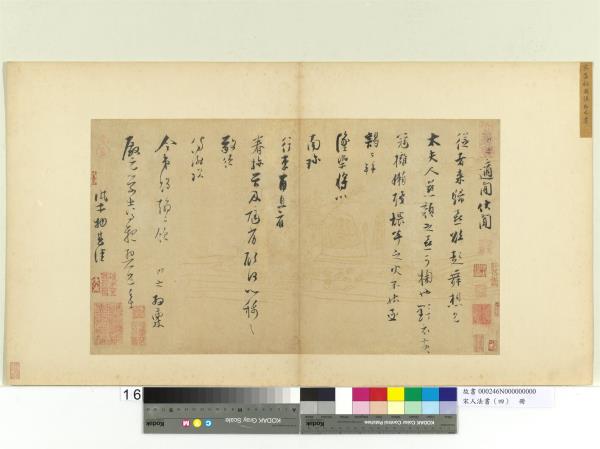
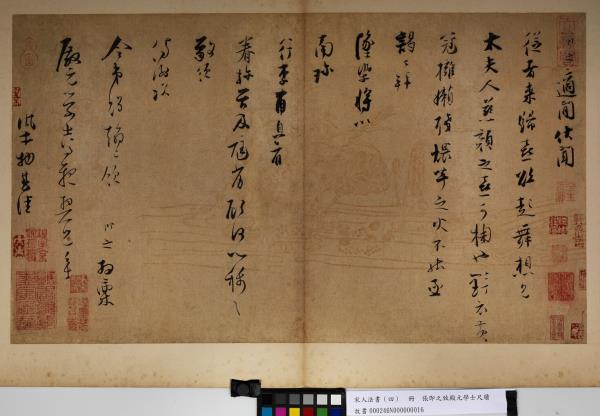


| 文物統一編號 | 故書000246N000000016 |
| 作品號 | 故書00024600016 |
| 品名 |
宋人法書(四) 冊 張即之致殿元學士尺牘 Letter to the Dianyuan Academician |
| 分類 | 法書 |
| 作者 | 張即之,Zhang Jizhi |
| 書體 | 行書 |
| 數量 | 一幅 |
| 作品語文 | 漢文 |
| 釋文 | 即之適間伏聞從者來歸。喜欲起舞。想見太夫人慈顏之喜可掬也。野衣黃冠。擁嬾殘煨芋之火。不能亟謁。己拜墜染。將以南珍。行李甫息肩。眷軫首及尩劣。顧何以稱之。敬須侍謝次。令弟賜翰己領。即之拜稟。殿元學士尊親契兄台坐。染物甚佳。 |
| 位置 | 尺寸(公分) |
|---|---|
| 本幅 | 30.7x53.6 |
| 質地位置 | 質地 |
|---|---|
| 本幅 | 紙 |
| 題跋類別 | 作者 | 位置 | 款識 | 書體 | 全文 |
|---|---|---|---|---|---|
| 題籤 | 楷書 | 宋直秘閣張即之書。 |
| 印記類別 | 印主 | 印記 |
|---|---|---|
| 收傳印記 | (一半印不識) | |
| 收傳印記 | 項元汴 | 子京父印(半印) |
| 收傳印記 | 項元汴 | 子孫世昌(半印) |
| 收傳印記 | 項元汴 | 子孫永保 |
| 收傳印記 | 項元汴 | 天籟閣 |
| 收傳印記 | 項元汴 | 平生真賞 |
| 收傳印記 | 項元汴 | 退密 |
| 收傳印記 | 項元汴 | 項子京家珍藏 |
| 收傳印記 | 項元汴 | 項元汴印 |
| 收傳印記 | 項元汴 | 項墨林父祕笈之印(重一。一半印) |
| 收傳印記 | 項元汴 | 項墨林鑑賞章 |
| 收傳印記 | 安岐 | 儀周鑑賞 |
| 收傳印記 | 安岐 | 翰墨林鑑定章 |
| 收傳印記 | 項元汴 | 檇李項氏士家寶玩 |
| 收傳印記 | 安岐 | 无恙 |
| 類別 | 參考資料 |
|---|---|
| 內容簡介 | 張即之(西元1186-1266年),字溫夫,號樗寮,歷陽烏江人(今安徽省和縣)。他父親張孝伯是孝宗時重臣,官至資政殿大學士,參知政事。張即之以父蔭授承務郎,累官司農寺丞,知嘉興,授直秘閣致仕。是南宋著名畫家,書蹟很受金人欣賞,常以重金搜購,在日本也廣為流傳。此札可能書於晚年退休閒居之時,結字疏密相間,用筆靈巧飄逸,絲毫不見老態。本幅選自「宋人法書冊四」第十六幅。 |
| 內容簡介 | 張即之(西元1186-1266年),字溫夫,號樗寮,歷陽烏江人(今安徽省和縣)。他的父親張孝伯是孝宗時重臣,官至資政殿大學士,參知政事。張即之以父蔭授承務郎,累官司農寺丞,知嘉興,授直秘閣致仕。是南宋著名書家,書蹟很受金人欣賞,常以重金搜購,在日本也廣為流傳。張即之喜作擘窠大字,豐碑巨刻,散流江左。明陳鎏評其書云「大字古雅遒勁,細書尤俊健不凡。」本幅行書,凡十四行,共九十四字,可能書於晚年退休閒居之時,結字疏密相間,用筆靈巧飄逸,絲毫不見老態。本幅選自「宋人法書冊四」第十六幅。 |
| 內容簡介 | 張即之(1186-1266),字溫夫,別號樗寮,安徽和州人。父親張孝伯、伯父張孝祥均長於書法,早年在父執輩引領下,勤讀經史,留意翰墨文章。由於篤好佛老無心宦途,在任官軍器監丞、司農寺丞後,即請求奉祠,歸隱鄞縣翠巖山,時年尚未滿六十。這件書札為歸隱後之作,除了表明潛心佛老的意向之外,也向友朋猶然念及山中人再三致意。全文不到一百字,書法圓轉輕靈別具一種況味。(20101015) |
| Description | Zhang Jizhi (style name Wenfu, alternate sobriquet Shuliao) was a native of Hezhou, Anhui. Both his father Zhang Xiaobo and uncle Zhang Xiaoxiang were gifted calligraphers, so from an early age he came under the tutelage of his father’s generation, applying himself diligently to the study of the Classics and paying attention to writing and calligraphy. His fondness for Buddhism and Daoism combined with a lack of interest in pursuing an official career led Zhang Jizhi to apply for pensioned retirement after serving as Aide to the Director of Armaments and Aide in the Court of the National Granaries. He then went home to live in reclusion at Cuiyan Mountain in Yinxian, having not yet reached the Chinese age of sixty. This letter was written after returning home to live in reclusion. Besides expressing an inclination towards Buddhism and Daoism, Zhang expressed gratitude to his friend for thinking about him even while he was living as a recluse. The letter is less than a hundred characters, but the light and rounded calligraphy has a quality all its own.(20101015) |
| Description | Chang Chi-chih(style name Wen-fu; sobriquet Shu-liao)was a native of Wu-chiang(modern Ho county, Anhwei).His father, Chang Hsiao-po, was an important official who became Grand Scholar of the Tz'u-cheng Hall Participant in Determining Government Matters in the reign of emperor Hsiao-tsung(1163-1189). Due to his father's merits as an official, Chang Chi-chih was awarded the title of Gentleman for Rendering Service, and he later held such posts as Chief Minister of the Court of the Imperial Granaries and Prefect of Chia-hsing as well as serving in the Chih-pi Pavilion. He was a famous calligrapher of the Southern Sung dynasty, and his works were even appreciated by connoisseurs among the enemy of the Sung, the Chin, who paid handsomely for his works. Chang's pieces of calligraphy even made their way to Japan. Chang was said to have often written calligraphy in large characters, which were recarved in stone and transmitted through throughout the south. Ch'en Liu of the Ming once wrote that Chang's calligraphy"…..in large characters was elegantly archaic and strong, while his small characters were extraoridinarily handsome." This piece in running script is composed of 94 characters in 14 lines, and it may have been written by Chang chi-chih in his later years while living in retirement. The characters vary between dense and separated, and the use of the brush appears spirited and untrammeled, quite unlike that of an elderly man. This is the sixteenth leaf in the album Sung –jen fa-shu IV. |
| Description | Chang Chi-chih(style name Wen-fu; sobriquet Shu-liao)was a native of Wu-chiang(modern Ho county, Anhwei). His father, Chang Hsiao-po, was an important official who became Grand Scholar of the Tz'u-cheng Hall Participant in Determining Government Matters in the reign of emperor Hsiao-tsung(1163-1189). Due to his father's merits as an official, Chang Chi-chih was awarded the title of Gentleman for Rendering Service, and he later held such posts as Chief Minister of the Court of the Imperial Granaries and Prefect of Chia-hsing as well as serving in the Chih-pi Pavilion. He was a famous calligrapher of the Southern Sung dynasty, and his works were even appreciated by connoisseurs among the enemy of the Sung, the Chin, who paid handsomely for his works. Chang's pieces of calligraphy even made their way to Japan. This letter may have been written by Chang chi-chih in his later years while living in retirement. The characters vary between dense and separated, and the use of the brush appears spirited and untrammeled, quite unlike that of an elderly man. This is the sixteenth leaf in the album Sung –jen fa-shu IV. |
| 收藏著錄 | 石渠寶笈續編(乾清宮),第一冊,頁445-473 |
| 收藏著錄 | 故宮書畫錄(卷三),第一冊,頁178-214 |
| 收藏著錄 | 故宮歷代法書全集,第十三冊,頁64-105、181-190 |
| 參考書目 | 1.何傳馨,〈張即之致殿元學士尺牘〉,收入國立故宮博物院編,《宋代書畫冊頁名品特展》(臺北:國立故宮博物院,1995年初版一刷),頁252。 2.何傳馨,〈「七十件書畫冊頁名品特展」精選(三) — 張即之致殿元學士尺牘〉,《故宮文物月刊》,第148期(1995年7月),頁58-59。 3.王競雄,〈致殿元學士尺牘〉,收入何傳馨主編,《文藝紹興:南宋藝術與文化‧書畫卷》(臺北:國立故宮博物院,2010年十月初版一刷),頁381。 |
| 參考書目 | 何炎泉,〈宋人法書(四) 冊 張即之致殿元學士尺牘〉,收入《宋代花箋特展》(臺北:國立故宮博物院,2017.12),頁142-145、226。 |
| 參考書目 | 何傳馨,〈宋人法書(四) 冊 張即之致殿元學士尺牘〉,收入《文藝紹興-南宋藝術與文化‧書畫卷》(臺北:國立故宮博物院,2010.10),頁274-275、381。 |
100萬像素圖檔下載
600萬像素圖檔下載