| 文物統一編號 |
故畫001255N000000012
|
| 作品號 |
故畫00125500012 |
| 品名 |
名賢妙蹟 冊 明陸治彭澤高蹤
The Eminent Magistrate of P’eng-tse |
| 分類 |
繪畫 |
| 作者 |
陸治 |
| 數量 |
一幅 |
| 位置 |
尺寸(公分) |
| 本幅 |
34.2x23.8 |
| 對幅 |
34.2x23.8 |
| 題跋類別 |
作者 |
位置 |
款識 |
書體 |
全文 |
| 題籤 |
|
|
|
楷書 |
陸治彭澤高蹤 |
| 作者款識 |
陸治
印記 expand_more
|
本幅 |
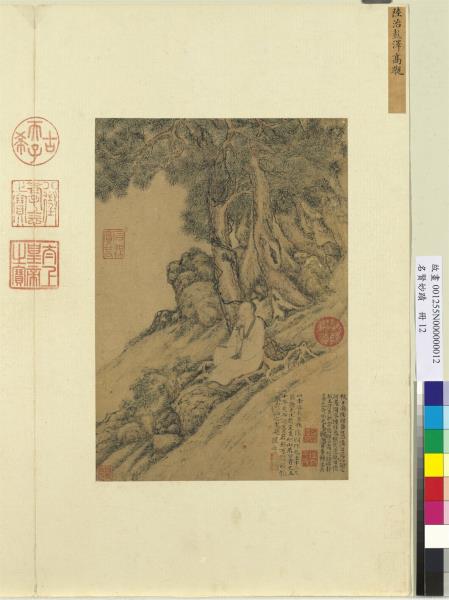
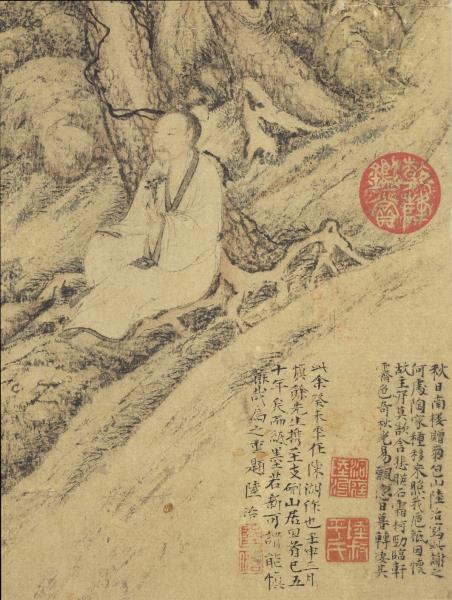
秋日南樓贈菊。包山陸治寫此謝之。何處陶家種。移來照我巵。祗因懷故主。寂莫欲含悲。 映石霜柯勁。臨軒霽色奇。秋光易飄忽。日暮轉凄其。 |
行楷書 |
|
|
|
| 作者款識 |
陸治
印記 expand_more
|
本幅 |
此余癸未年(西元一五二三年)任陳湖作也。壬申三月。慎餘先生攜至支硎山居。回首已五十年矣。而紙墨若新。可謂能慎餘哉。為之重題。陸治。 |
行楷書 |
|
|
|
| 題跋 |
清高宗
印記 expand_more
|
對幅 |
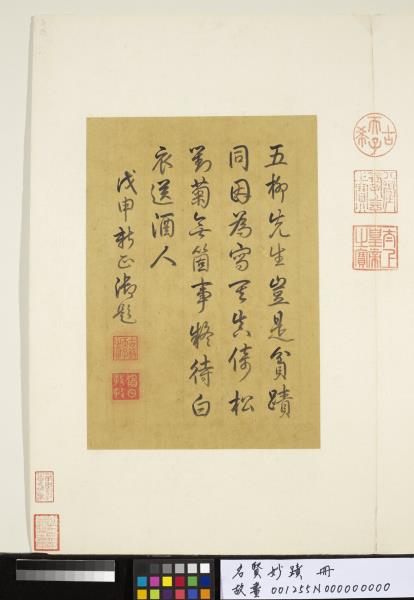
戊申新正御題 |
行書 |
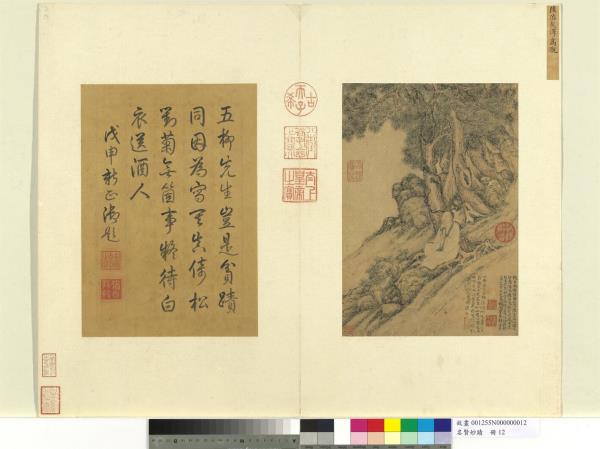
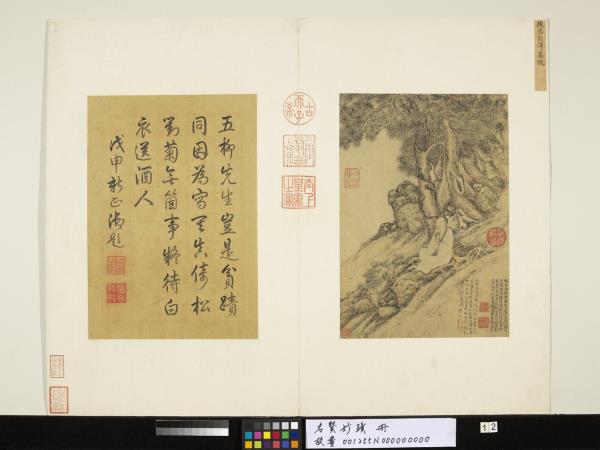
五柳先生豈是貧。蹟同因為寫其真。倚松對菊無箇事。疑待白衣送酒人。戊申(西元一七八八年)新正御題。 |
| 印主 |
印記 |
| 清高宗 |
古稀天子之寶 |
| 清高宗 |
猶日孜孜 |
|
| 印記類別 |
印主 |
印記 |
| 收傳印記 |
|
陳定畫印 |
| 鑑藏寶璽 |
清高宗 |
八徵耄念之寶 |
| 鑑藏寶璽 |
清高宗 |
太上皇帝之寶 |
| 鑑藏寶璽 |
清高宗 |
古希天子 |
| 鑑藏寶璽 |
清高宗 |
石渠寶笈 |
| 鑑藏寶璽 |
清高宗 |
乾隆鑑賞 |
| 主題類別 |
主題(第一層) |
主題(第二層) |
主題說明 |
| 主要主題 |
人物 |
高士(士人、隱士) |
陶淵明 |
| 主要主題 |
樹木 |
松 |
|
| 其他主題 |
山水 |
|
|
| 其他主題 |
花草 |
菊 |
|
| 技法 |
技法細目 |
| 人物衣紋描法(勻稱線條) |
|
| 皴法 |
|
| 寫意 |
|
| 類別 |
參考資料 |
| 內容簡介 |
陸治,生平小傳另見。
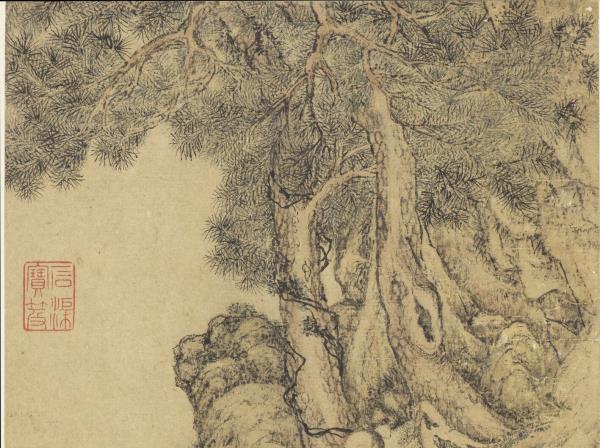
畫陶淵明手持菊花,坐於山坡上,青松兩棵,駢列於後。作畫時在嘉靖癸未(西元一五二三)陸治二十八歲,授館於陳湖,李昭祥贈菊花,因寫此畫為謝。五十年後,隆慶壬申(西元一五七二),李昭祥又攜此畫請陸治重題,陸治已隱居於支硎山中。陶淵明和郭主簿詩:「芳菊開林耀,青松冠巖列,懷此貞秀姿,卓為霜下傑。」此畫陸治題詩云:「陶家種」,以菊與陶淵明之聯想,再讀陶詩,顯然借陶淵明以自況。畫雖為少作,卻老成有餘。
|
| 內容簡介 |
陸治(西元一四九六-一五七六年),江蘇吳縣人。字叔平,號包山子。畫山水折衷四大家,近則受沈周、文徵明影響,晚年用墨愈枯淡,用筆愈方勁,自成一格。
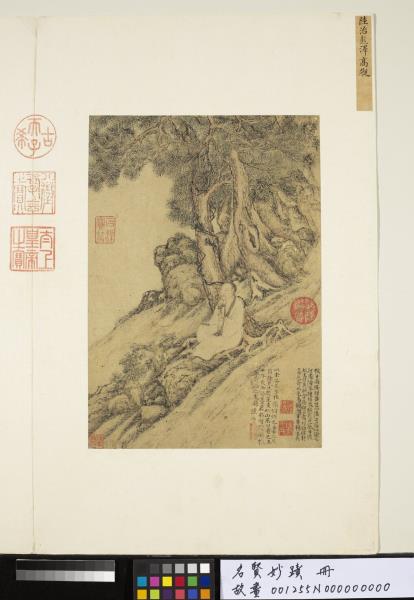
青松樹下,陶淵明手持菊花而坐。幅左陸氏自題詩云:「何處陶家種」,有借陶淵明以自況之意。全作以乾筆成之,設色淡雅,別具明淨清雅之韻。時陸治二十八歲,雖為少作,卻老成有餘。本幅選自「名賢妙蹟冊」第十二幅。
|
| Description |
Lu Chih, a native of Kiangsu province, combined the painting styles of the Four Masters of the Yuan with those of Shen Chou and Wen Cheng-ming. In later years, he used dry ink sparingly to create mountains of unusual shape and texture.
Under pine trees, Tao Yuan-ming sits on a slope holding a sprig of chrysanthemums. Lu Chih has borrowed the figure of T’ao Yuan-ming to refer to himself in the inscription; “Where has the T’ao chrysanthemum gone?” Painted in dry ink, the coloring is light and elegant for a pure and luminous quality. This was done by Lu at the age of 27. Though painted in his youth, the style is quite mature. This work is the 12th leaf from Album of Works by Famous Worthies.
|
| Description |
T’ao Yuan-ming sits on a rocky slope beneath the pines, holding in his hand a sprig of chrysanthemums.
Lu Chih painted this scroll in 1523 at the age of twenty-seven. Once when he was teaching near Lake Ch’en in Kiangsu a certain Li Chao-hsiang presented him with a gift of chrysanthemums, and Lu gave him this painting as a return gift. Fifty years later, when Lu was living in retirement in the Chih-hsing Mountains in Kiangsu, Li in 1572 again brought Lu the painting and asked him to add another colophon.
The painting perhaps refers to T’ao Yuan-ming‘s lines “The fragrant chrysanthemums bloom and light up the forest; green pines crown the cliff ridge. I muse at their pristine beauty, as they yet stand stalwart beneath the frost.” To the scroll Lu Chih added the phrase “A variety of mum like that of the T’ao family,” a phrase that associates the work with T’ao Yuan-ming, even though the man in the painting probably refers to the artist himself.
Lu Chih was a native of Wu County, Kiangsu. Not only a painter, he was also an accomplished poet, writer, and calligrapher.
|
| 參考書目 |
1.王耀庭,〈明陸治彭澤高蹤〉,收入王耀庭編,《淵明逸致特展圖錄》(臺北:國立故宮博物院,1988年初版),頁94-95。
2.王耀庭、張華芝,〈明陸治彭澤高縱〉,收入王耀庭、張華芝編,《明陸治作品展覽圖錄》(臺北:國立故宮博物院,1992年初版),頁67。
3.江兆申,〈陸冶彭澤高蹤 冊〉,收入國立故宮博物院編,《吳派畫九十年展》(臺北:國立故宮博物院,1975年初版,1976年再版,1981年三版),頁294。
|
| 收藏著錄 |
故宮書畫圖錄,第二十九冊,頁136-145
|
| 收藏著錄 |
故宮書畫錄(卷六),第四冊,頁243-245
|
| 收藏著錄 |
石渠寶笈續編(養心殿),第二冊,頁1105-1106
|
| 網頁展示說明 |
這是目前陸治傳世最早的作品,作於二十八歲。當時陸治在陳湖教書,好友李昭祥送來菊花,陸治因此畫這幅畫表示答謝。畫中涵義和晉代隱士陶淵明有關,陶淵明在歸隱故鄉之後,除了讀書、寫作充實自己之外,也種菜、種花,像老農、老圃一樣過日子。陶淵明喜歡自耕自食的生活,以他的價值觀看來,這比在朝作官適合自己,不需要委曲求全,反而失去了真正的自己。陶淵明的選擇得到世人尊重,歷來詩人、畫家常在作品裡讚美他這種真實不虛假的美德。由於陶淵明喜歡菊花,很自然地就用菊花來象徵隱士脫俗的人格。陸治畫中的陶淵明倚坐在松樹下菊花前,彷彿很逍遙自在,實際上並非如此。陶淵明雖然隱居,並沒有忘記自己對社會的責任,從他流傳下來的詩文,可以知道他在文學領域中貢獻自己,做好自己份內的事,陸治選擇畫陶淵明,這也是原因之一。
|
| 網頁展示說明 |
At present, this is the earliest surviving painting by Lu Chih. It dates to 1423, when he was 27. At that time, Lu Chih was teaching at Lake Ch’en when his friend Li Chao-hsiang visited him and presented him with chrysanthemums. Lu painted this work to show his gratitude.
This painting represents the great poet-recluse T’ao Yuan-ming (365-427), who spent his days in reclusion gardening, writing, and studying. T’ao felt that such a life was more suitable for him than that of an official, having once served as the magistrate of P’eng-tse (hence the title of this painting). For his integrity and simplicity, T’ao has been venerated ever since by poets and painters. T’ao especially loved the humble chrysanthemum, which stands out by blooming late in the season during autumn and thereby symbolizing the reclusive scholar who blossoms later in life. Lu has shown T’ao seated under pine trees in front of chrysanthemums and holding some blossoms in a state of ease. T’ao, like Lu Chih, did not take reclusion as an excuse for doing nothing, for they both took the opportunity to create. Thus, with regards to chrysanthemums, it was natural for Lu Chih to choose T’ao Yuan-ming as a model.
Lu Chih also borrowed the figure of T’ao Yuan-ming in his self-reflective inscription; “Where has the chrysanthemum of T’ao gone?” Painted in dry ink, the coloring in this work is light and elegant for a pure and luminous quality. Though painted in Lu’s youth, the style here already appears quite mature.
|
本院文物保存維護依〈國立故宮博物院典藏文物管理作業要點〉及〈國立故宮博物院文物修護業務作業原則〉辦理
抽盤點紀錄
修護紀錄